1. What Does Predictive Maintenance Mean for Transformers?
Calendar maintenance can service a healthy transformer too early and miss a rapidly developing defect between intervals. A prediction label is not useful unless the evidence and next action are visible. This matters to reliability managers, utility asset teams and industrial maintenance leaders.
Start by naming the transformer component, the expected fault or operating change, and the decision the measurements must support. The scope for transformer predictive maintenance using condition data must remain tied to that purpose.
Predictive maintenance combines verified trends, operating exposure, inspection history and asset consequence. It recommends the next check or test; it does not promise an exact failure date. The measurement path must remain traceable from sensor to alarm.
Useful evidence comes from condition trend persistence, rate of change and asset criticality. These measurements should help the owner move from calendar-only work toward evidence-led inspection and maintenance timing without claiming certainty.
A good result is not another dashboard value. It is a clear answer about which assets receive online monitoring, supported by measurements that the maintenance team can check.
Predictive maintenance does not mean predicting an exact failure date. It means using a verified change in condition to choose the next inspection, test or maintenance task before a fixed calendar interval would require it.
2. How Failure Modes Determine the Useful Sensor Set
Transformer construction and the required decision determine the suitable method. Relevant inputs include condition trend persistence, rate of change, asset criticality and failure-mode evidence.
Predictive maintenance combines verified trends, operating exposure, inspection history and asset consequence. It recommends the next check or test; it does not promise an exact failure date. Record where each value originates and which operating condition can change it.
Near term: persistent adverse trend with corroboration. Verification point: Plan targeted inspection or diagnostic test. Keep the channel identity, units, timestamp and instrument status with the result.
Using an unexplained health score can make a correct instrument look misleading. Check the measurement method and the transformer state before assigning a fault.
The sensor set should follow failure modes. Temperature and cooling inputs address thermal stress; DGA follows oil and paper decomposition; PD observes discharge activity; bushing and OLTC measurements cover important components outside the main tank diagnosis.
3. How Temperature, DGA, PD, Bushing and OLTC Trends Are Combined
Temperature reveals thermal stress, DGA follows chemical decomposition in oil and paper, partial-discharge monitoring captures localized electrical activity, and oil sensors follow moisture, level, pressure and bulk thermal condition. These methods overlap in fault coverage but do not measure the same physical phenomenon.
Planned outage: slow deterioration or repeated abnormal operation. Verification point: Add work scope and parts preparation. Keep the channel identity, units, timestamp and instrument status with the result.
Review asset criticality together with failure-mode evidence. Their direction, timing and persistence help separate a transformer change from normal operation or a sensor problem.
For asset criticality, document the physical point, range, sampling behavior and expected output. This makes commissioning and later troubleshooting much easier.
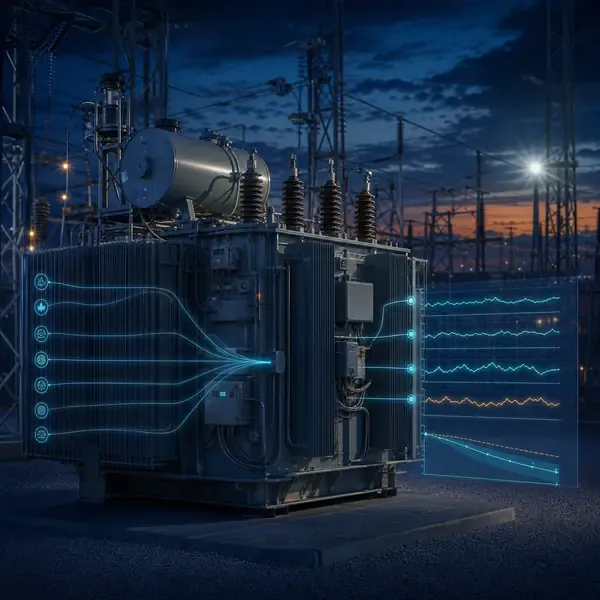
Combining data does not mean averaging everything into one score. Each signal keeps its physical meaning, update rate and limitation. Corroboration is strongest when independent measurements support the same developing condition.
| Decision horizon | Useful evidence | Typical action |
|---|---|---|
| Immediate | Fast gas, discharge, pressure or thermal escalation | Verify data and apply emergency procedure |
| Near term | Persistent adverse trend with corroboration | Plan targeted inspection or diagnostic test |
| Planned outage | Slow deterioration or repeated abnormal operation | Add work scope and parts preparation |
| Fleet planning | Comparable condition and consequence data | Prioritize capital and maintenance resources |
4. Why Data Quality Must Be Checked Before Health Scoring
Predictive maintenance combines verified trends, operating exposure, inspection history and asset consequence. It recommends the next check or test; it does not promise an exact failure date.
The signal path for failure-mode evidence runs from the sensing point through cables, optical leads or an oil loop to the acquisition unit. Local processing stores the record and sends selected values or alarms onward.
Fleet planning: comparable condition and consequence data. Verification point: Prioritize capital and maintenance resources. Keep the channel identity, units, timestamp and instrument status with the result.
Sampling and storage for inspection and test confirmation must match the physical event. Slow oil movement, a brief OLTC operation and a high-frequency PD pulse need different acquisition settings.
Check missing data, failed sensors, configuration changes and maintenance events before calculating priority. A high score built from stale or substituted values can misdirect a maintenance crew.
Compare available transformer monitoring products and instruments after the sensor locations, channel quantity and required outputs are known.
5. How Rate, Persistence and Consequence Set Maintenance Priority
Field example: A slow moisture rise may justify a planned sample at the next visit. A rapid gas increase on a critical transformer may justify immediate confirmation. The same numeric change can therefore lead to different schedules when consequence and rate differ.
Inspection and test confirmation alone does not explain the result. Condition trend persistence provides the comparison needed to test the first explanation.
Record whether each recommendation was confirmed, dismissed or corrected by maintenance. That feedback improves alarm settings and exposes sensors or rules that create repeated false findings.
This evidence helps determine which assets receive online monitoring. Depending on severity and confidence, the next step may be continued trending, inspection, a controlled sample or an offline test.
Priority depends on both condition and consequence. A modest but fast change on a critical transformer may deserve earlier action than a stable high historical value on a unit with redundancy.
6. How Online Alarms Trigger Inspection and Offline Tests
An actionable alarm separates absolute level, rate of change, persistence and instrument health. The setting must identify an owner and response; otherwise a threshold creates a notification but no maintenance decision.
Review condition trend persistence together with rate of change. Their direction, timing and persistence help separate a transformer change from normal operation or a sensor problem.
Near term: persistent adverse trend with corroboration. Verification point: Plan targeted inspection or diagnostic test. Keep the channel identity, units, timestamp and instrument status with the result.
After sensor replacement, oil processing or a configuration change, mark a new comparison period for condition trend persistence. Otherwise maintenance may look like sudden deterioration or recovery.
The online alarm should open a defined confirmation path. The next step may be an inspection, laboratory oil sample, infrared survey, electrical test or review of operating history rather than immediate component replacement.
7. Why Remaining-Life Claims Need Transparent Assumptions
A recommendation should name the changed evidence, confidence, consequence, time horizon and confirming action.
Automating action without engineering review is a significant interpretation risk for rate of change. Preserve the original reading and compare it with an independent observation before escalating.
Record whether each recommendation was confirmed, dismissed or corrected by maintenance. That feedback improves alarm settings and exposes sensors or rules that create repeated false findings.
This evidence helps determine what evidence changes maintenance timing. Depending on severity and confidence, the next step may be continued trending, inspection, a controlled sample or an offline test.
Remaining-life estimates depend on thermal models, material assumptions and operating history that may be incomplete. Show the assumptions and uncertainty instead of presenting one date as a guaranteed end of life.
- Calling every dashboard predictive — check the sensor, operating state and related measurements before assigning a transformer fault.
- Using an unexplained health score — check the sensor, operating state and related measurements before assigning a transformer fault.
- Automating action without engineering review — check the sensor, operating state and related measurements before assigning a transformer fault.
- Failing to record false alarms and confirmed findings — check the sensor, operating state and related measurements before assigning a transformer fault.
8. Which Assets Should Enter a Predictive Monitoring Program First?
Send the nameplate, general arrangement, installation stage and available drawings with the inquiry. Mark the locations related to condition trend persistence and rate of change and identify existing instruments that may be reused.
Ask how the offered equipment handles condition trend persistence: where it is measured, how often it is recorded, which alarm uses it and what appears in the delivered test report.
Assign responsibility for connect maintenance and test history to the asset record, approval of which assets receive online monitoring, and final acceptance.
Before production, freeze the options that affect condition trend persistence. The order should list tests, configuration files, documentation language, commissioning records and support responsibilities.
Review the related transformer monitoring solution before selecting instruments for condition trend persistence.
9. What Evidence and Model Transparency Should a Supplier Provide?
Best for fleets with reliable history, clear maintenance ownership and enough asset criticality difference to support risk-based prioritization. Start with the transformer, the problem to be detected and the action expected after an alarm. The scope must clarify how health indications are reviewed.
For rate of change, require the exact model, quantity, range, accessories, outputs and communication interface. Optional work should be separated from the base supply.
Split field responsibilities before ordering transformer predictive maintenance using condition data. The quotation should assign responsibility for keep model inputs and weights auditable and approval of how health indications are reviewed.
The purchase record for transformer predictive maintenance using condition data should show what arrives on site and how it will be checked. Do not replace measurable acceptance criteria with a promise to predict every failure.
| Proposal item | What the buyer should verify | Why it changes the comparison |
|---|---|---|
| Decision workflow and responsible roles | Included model, quantity, performance basis and responsibility | Prevents unlike hardware scopes from appearing equivalent |
| Source-data quality and auditability | Drawing, interface, test method and delivered record | Prevents installation and commissioning work from becoming an unpriced change |
| Model validation and change control | Included model, quantity, performance basis and responsibility | Prevents unlike hardware scopes from appearing equivalent |
| Integration with work orders and maintenance records | Drawing, interface, test method and delivered record | Prevents installation and commissioning work from becoming an unpriced change |
10. How Should Success, Support and Data Ownership Be Contracted?
Compare model validation and change control and integration with work orders and maintenance records before comparing price. Two proposals are not equivalent when one includes field sensors, cables, drawings and commissioning while the other lists only the monitor.
The proposal for transformer predictive maintenance using condition data should tie asset criticality to a model, measurement point, stated performance basis and included installation parts. This makes price differences explainable.
Installation and testing cannot remain an undefined site task. Assign responsibility for separate urgent alarms from planning recommendations and final review of what evidence changes maintenance timing.
Approve equipment release only after the bill of materials, channel list, drawings, alarm behavior, tests and documents are complete. Acceptance for asset criticality must demonstrate the specified readings and interfaces.
- Decision workflow and responsible roles
- Source-data quality and auditability
- Model validation and change control
- Integration with work orders and maintenance records
- Transformer details relevant to condition trend persistence, rate of change and asset criticality
- Approved channel list, interfaces, tests and documentation